Eliminating Hidden API Consumption Costs
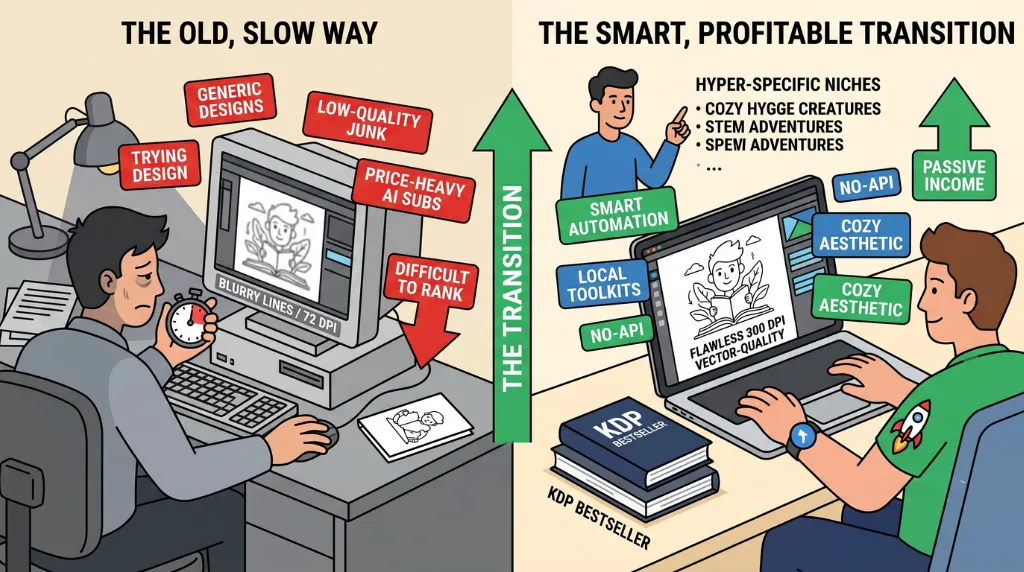
Most online AI graphics tools trap you in monthly subscriptions or charge you for every single image credit through third-party APIs. When you are trying to test out new book ideas and generate dozens of trial pages, those hidden API fees will absolutely destroy your profits.
The smartest way around this is using software that handles the heavy lifting locally. By shifting the workload away from cloud servers, you can iterate, rebrand, and generate endless variations of your book without ever staring at a scary surprise bill at the end of the month.
Overcoming Resolution Degradation and Printing Artifacts
Amazon is incredibly strict about printing quality. If you upload low-res web graphics (usually 72 or 96 DPI), the final printed book will look blurry, pixelated, and completely unprofessional. To pass quality control and satisfy buyers, your interior must be delivered as a crisp, 300 DPI print-ready PDF. Your linework needs to be completely smooth and solid black, ensuring that the physical book looks like it was drawn by a professional human artist.
3. Optimizing Your Book for the Amazon KDP Algorithm
Great interiors won’t make you a dime if nobody can find your book on Amazon. You have to optimize your KDP metadata so the search algorithm knows exactly who should see your listing.
Metadata Spot
How to Fix It
Why It Matters
Book Title
Put your exact niche and target age right up front.
Immediate ranking boost for main terms.
Subtitle
Explain the style of art and the exact emotional benefit.
Gets casual browsers to click your listing.
7 Backend Slots
Fill them with unique, long-tail search phrases.
Matches random, specific customer searches.
A+ Content
Show real mockups of what the inside pages look like.
Builds instant trust so people buy on the spot.
>>You can find more details here<<.
Advanced Subtitle Engineering
Keep your main title short, catchy, and easy to remember. Use your subtitle to do the heavy lifting for keywords. Do not just stack random words together — Amazon hates keyword stuffing and might ban your account. Make it read naturally while hitting your target search phrases.
Optimized Subtitle Blueprint: A Bold and Easy Cozy Coloring Book for Kids Ages 4–8, Featuring Simple and Cute Designs for Stress Relief and Mindfulness.
This sentence naturally grabs buyers searching for bold and easy, cozy coloring book, kids ages 4–8, and stress relief all at once, without looking like spam.
Strategic Selection of the 7 Backend Keywords
Amazon gives you seven backend slots to catch extra traffic. Do not waste this space by repeating words that are already in your title. Do not use commas either — just type out long phrases using normal spaces. Target highly specific terms like printable coloring pages PDF, anxiety relief coloring book, and minimalist line art.
4. Revolutionary Production Workflows: Moving to Client-Side Systems
If you want to protect your margins and scale up a massive library of books, you have to break away from expensive cloud setups. The smartest publishers are moving toward 100% client-side processing applications.
Harnessing Local Hardware Architecture
By building apps with modern client-focused frameworks like Next.js and TypeScript, all the file compiling happens right inside your computer’s local RAM and browser environment. This means your private prompt lists, book templates, and rough drafts never get uploaded to someone else’s server, keeping your hard work completely safe from copycats and data leaks.
[Your Computer’s RAM & Browser] ──(No Cloud Uploads)──> Instant 300 DPI PDF Ready to Sell
Eliminating Recurring Overhead Expenses
When your software runs entirely on your own machine, you do not have to pay for server maintenance or monthly cloud hosting. That drops your production cost to zero, leaving you with way more cash to pump into Amazon PPC ads to jumpstart your sales. You can create, tweak, and export hundreds of high-res interiors for free.
5. Designing High-Converting Interiors: Step-by-Step
A great coloring book needs to follow a few simple, non-negotiable layout rules to keep buyers happy and earn those crucial five-star reviews:
- Always Stick to Single-Sided Pages: Only put your designs on the right-hand pages, leaving the back sides completely blank. This prevents heavy markers from ruining the next drawing and lets users easily cut out their art to hang it up.
- Get Your Bleed Settings Right: Make sure your digital canvas accounts for Amazon’s physical cutting machines. For a classic $8.5 \times 11\text{ inch}$ book, sizing your project file to exactly $8.625 \times 11.25\text{ inches}$ keeps your backgrounds looking perfect without awkward white edges after cutting.
- Keep Your Outlines Consistent: Do not mix light, sketchy pencil lines on one page with thick, heavy marker lines on the next. It looks lazy and cheap. Keep your outlines bold, clean, and completely closed so the coloring experience feels smooth and satisfying.
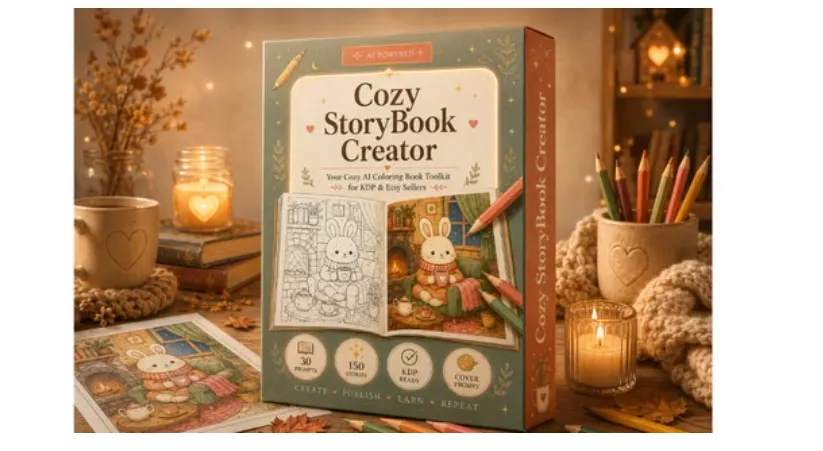
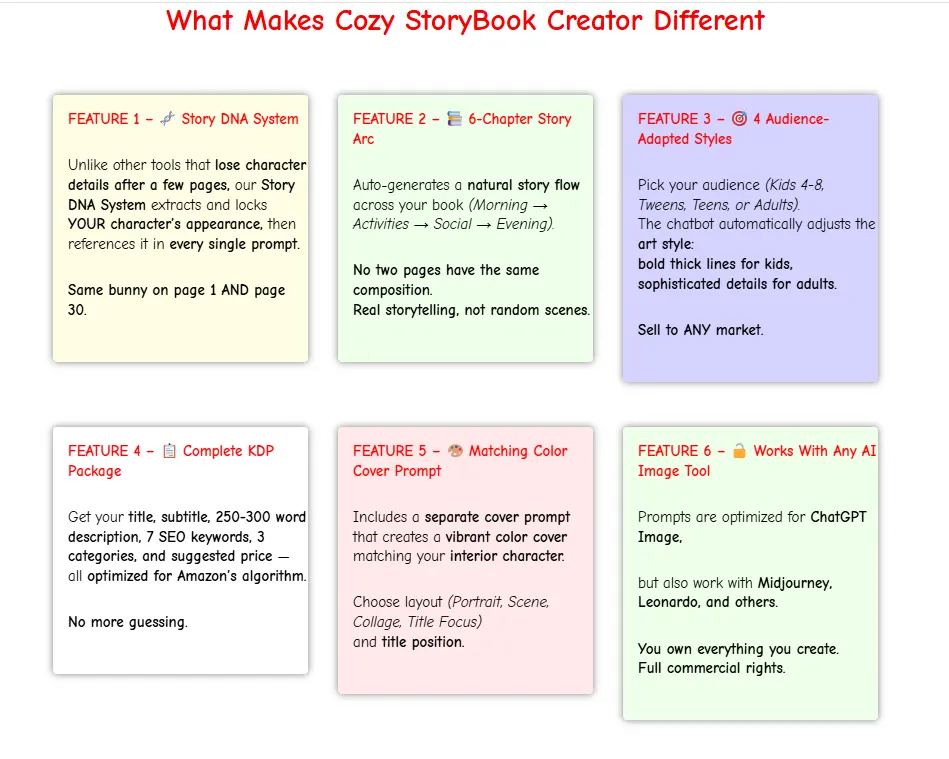
By sticking to these clear quality standards, choosing no-API local client-side software engines, and using targeted systems like Cozy StoryBook Creator to fix character and resolution issues, you can easily out-publish the competition and build a highly profitable book portfolio on Amazon KDP.